The expo theme this year is Blending Africa’s Finesse with Global Business. That phrase does a lot of work in six words. It names both an asset and a problem. The finesse exists. The blending with global business, the commercial translation of that finesse into price, margin, and market position, is what most African tea and coffee producers have not yet fully figured out.
This is not a new observation. In Article 01 of this series, I showed that Rwandan tea already fetches $3.24 per kilogram at Mombasa against a market average of $2.05, which is the highest of any origin on the floor. And in The Extraction Reflex, I named the behavioral pattern that keeps most African producers selling at the low end of the market they could own. This article moves from diagnosis to decision. Five specific behavioral choices separate the producers who are winning the premium tier from those who are not.
THE MARKET THEY ARE MISSING
The global specialty coffee market was valued at $111.5 billion in 2025 and is projected to reach $123.3 billion in 2026, growing at a compound annual rate of 10.8% through 2036, according to Fact.MR market data. That is roughly double the growth rate of the overall coffee market. Single-origin products, the format most naturally suited to African origins with distinct terroir, are growing at 6.86% annually through 2031.
| Market Segment | 2025 Value | Growth Rate | Who Benefits |
| Global coffee market | $185-263B | 5.2% CAGR | Volume exporters |
| Specialty coffee market | $111.5B | 10.8% CAGR | Origin-branded producers |
| Single-origin coffee | $14.8B | 6.86% CAGR | Named-terroir origins |
| Specialty coffee shops | $108.8B | 11.9% CAGR | Supply chain partners |
| Middle East & Africa region | Fastest growing | 8.16% CAGR | African domestic market |
Sources: Fact.MR Specialty Coffee Market 2026; Mordor Intelligence Coffee Market 2026; Market Research Future Single-Origin Coffee 2025
The Middle East and Africa region is the fastest-growing segment of the global coffee market at 8.16% annually through 2031, according to Mordor Intelligence. That means the premium market is growing fastest in Africa’s own backyard. The domestic and regional consumer who is willing to pay for quality and origin story is increasingly African, increasingly young, and increasingly urban. The producers who position themselves for that consumer now will not need to wait for European or North American buyers to validate them.
Transparency is no longer a differentiator in specialty coffee. It is an expectation, as industry analysis from 2026 consistently shows. Coffee brands that cannot provide origin details are losing credibility with the consumers who matter most to premium pricing. African producers have the origin details. The decision is whether to use them.
| The premium market is not waiting for Africa to be ready. It is growing fastest in Africa’s own backyard. |
THE FIVE BEHAVIORAL DECISIONS
The five decisions below are not production decisions. No new infrastructure, no new certification, and no new export relationship is required before any of them can be made. They are decisions about how a producer chooses to show up in the market, and they are replicable at any scale.
FIVE BEHAVIORAL DECISIONS THAT MOVE AFRICAN TEA AND COFFEE INTO THE PREMIUM TIER |
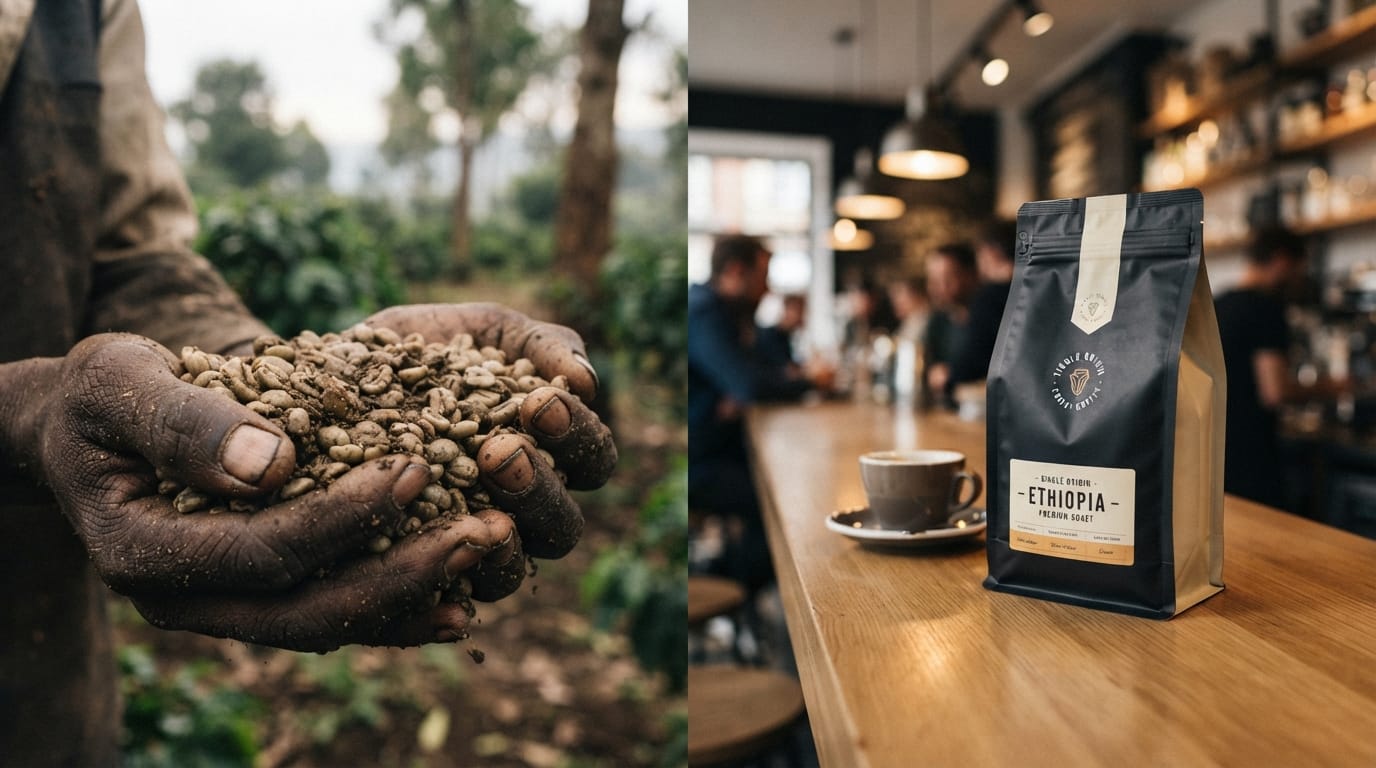
| DECISION 1: NAMING THE ORIGIN BEFORE SOMEONE ELSE NAMES IT FOR YOU. Ethiopia registered Yirgacheffe, Sidamo, and Harar as international trademarks in 2004. Two decades later, those names command price premiums that their trademark status protects. Rwanda’s factory marks, Kitabi, Nyabihu, Rubaya, and Gatare, already carry price records at the Mombasa Tea Auction. The decision is whether to treat those names as catalog entries or as brand assets. A catalog entry describes provenance. A brand asset builds buyer expectation that compounds into price. The single-origin coffee market is projected to reach $23.19 billion by 2034. African origins will not capture a proportional share of that market by remaining unnamed in the buyer’s mind. |
| DECISION 2: INVESTING IN STORY BEFORE INVESTING IN SCALE. Perfect Daily Grind’s 2026 reporting on North Africa’s specialty coffee growth found a consistent pattern in the markets gaining traction: design, social media presence, and signature beverages drive traffic and pricing power, not volume alone. The same dynamic applies to origin producers. A cooperative or estate that tells the story of its altitude, its processing method, its farmer community, and its harvest season is competing for a different buyer than one that presents only grade and weight. The buyers who are willing to pay a 30 to 50 percent premium for traceable, single-estate beans, as Market Research Future found for the specialty category, are making an identity-driven purchase as much as a quality-driven one. Story is not supplementary to the product. It is the product for that buyer. |
| DECISION 3: CHOOSING CONSISTENCY OVER HEROIC LOTS. The Rwanda Mountain Tea Kitabi BP1 lot that fetched $7.12 per kilogram at Mombasa Sale 44 in October 2024 is the most-cited number in Rwanda’s tea sector right now. It deserves to be. But the $3.24 average across all Rwandan tea at the 2025 Mombasa auction is the number that pays the sector’s bills. Specialty coffee and tea buyers at the premium tier are not buying outlier performances. They are building menus and blends that need to hold across six to twelve months. Consistency converts attention into relationship, and relationship converts into price floor. The heroic lot attracts the buyer. The consistent lot keeps them. |
| DECISION 4: TREATING DOMESTIC AND REGIONAL BUYERS AS FIRST-TIER MARKETS. North Africa is experiencing rapid growth in branded specialty coffee, with Morocco and Egypt among the top three fastest-growing coffee shop markets in the MENA region by outlet count, according to Perfect Daily Grind. Nairobi, Lagos, Accra, and Kigali are each developing specialty coffee cultures among younger, urban consumers who actively seek origin and quality signals. African producers who wait for validation from London or Tokyo before positioning themselves as premium in their own backyard are conceding a first-mover advantage in the fastest-growing regional market for their product. AfCFTA creates the trade architecture. The positioning decision has to come first. |
| DECISION 5: PUBLISHING THE DATA. Premium pricing in commodity markets is justified through documented proof. The Mombasa auction result for Kitabi BP1 became a market signal precisely because NAEB published it, EATTA recorded it, and industry media covered it. Most African cooperatives, estates, and factories that achieve comparable quality signals never publish them. They do not issue a press release. They do not build a data trail that a buyer in Germany or a specialty importer in Japan can point to when justifying a premium contract to their own clients. The specialty coffee buyer’s due diligence starts online. What they find, or do not find, about an origin’s track record shapes what they are willing to offer before they ever taste the cup. |
WHY THESE FIVE DECISIONS BELONG ON THE ACT EXPO AGENDA
The Africa Coffee and Tea Expo 2026 is the first continental platform where these five decisions can be made, demonstrated, and validated simultaneously. The buyers who pay premiums for single-origin, traceable, story-backed African coffee and tea are in Kigali this week. The producers who have made one or more of these decisions are here to demonstrate them. The policymakers and investors who need to see proof before they finance the next stage are watching.
The specialty market is not waiting for the average African producer to be ready. It is growing at 10.8% annually and selecting its supply partners now. The behavioral decisions in this article are available to any producer regardless of their current scale. The question I keep returning to, across everything I research in African agribusiness, is whether the actors in the room are here to observe the premium market or to participate in it. Both options are available in Kigali this July. Only one of them compounds.
The Extraction Reflex I described in Article 03 is the default. These five decisions are the deliberate alternative. And as I wrote in Explore Before You Exploit, the producers who take the time to understand the premium market before optimizing for volume are the ones who end up defining it.
FREQUENTLY ASKED QUESTIONS
Why is the specialty coffee market growing faster than the overall coffee market?
The global specialty coffee market is expanding at a 10.8% compound annual rate through 2036, roughly double the growth rate of the overall coffee market, according to Fact.MR. The growth is driven by younger consumers, particularly the 18 to 24 age group which accounts for 32 to 44 percent of specialty coffee purchasing, who treat coffee as an identity and values-based choice rather than a commodity purchase. They seek transparency, origin story, sustainability credentials, and traceability, signals that African producing countries are well-positioned to provide but have not yet systematically packaged.
What are the five behavioral decisions that separate premium-priced African coffee and tea from commodity competitors?
The five decisions are: naming the origin before someone else defines it generically; investing in story before investing in scale; choosing consistency over heroic lots; treating domestic and regional African consumers as first-tier premium buyers rather than waiting for European or North American validation; and publishing auction results, quality data, and origin track records so that specialty buyers can build a due-diligence case before contact. None of these requires new infrastructure. All of them require a deliberate choice about how the producer shows up in the market.
Which African region is growing fastest as a specialty coffee consumer market?
The Middle East and Africa region is the fastest-growing segment of the global coffee market, projected at an 8.16% compound annual growth rate through 2031, according to Mordor Intelligence. North Africa is leading within this, with Morocco and Egypt among the top three fastest-growing branded coffee shop markets in MENA by outlet count as of 2025, driven by younger, urban consumers who have encountered specialty coffee internationally and now want the same quality and origin transparency at home. African producers who position themselves for this regional consumer now hold a first-mover advantage in the fastest-growing segment of their own market.