
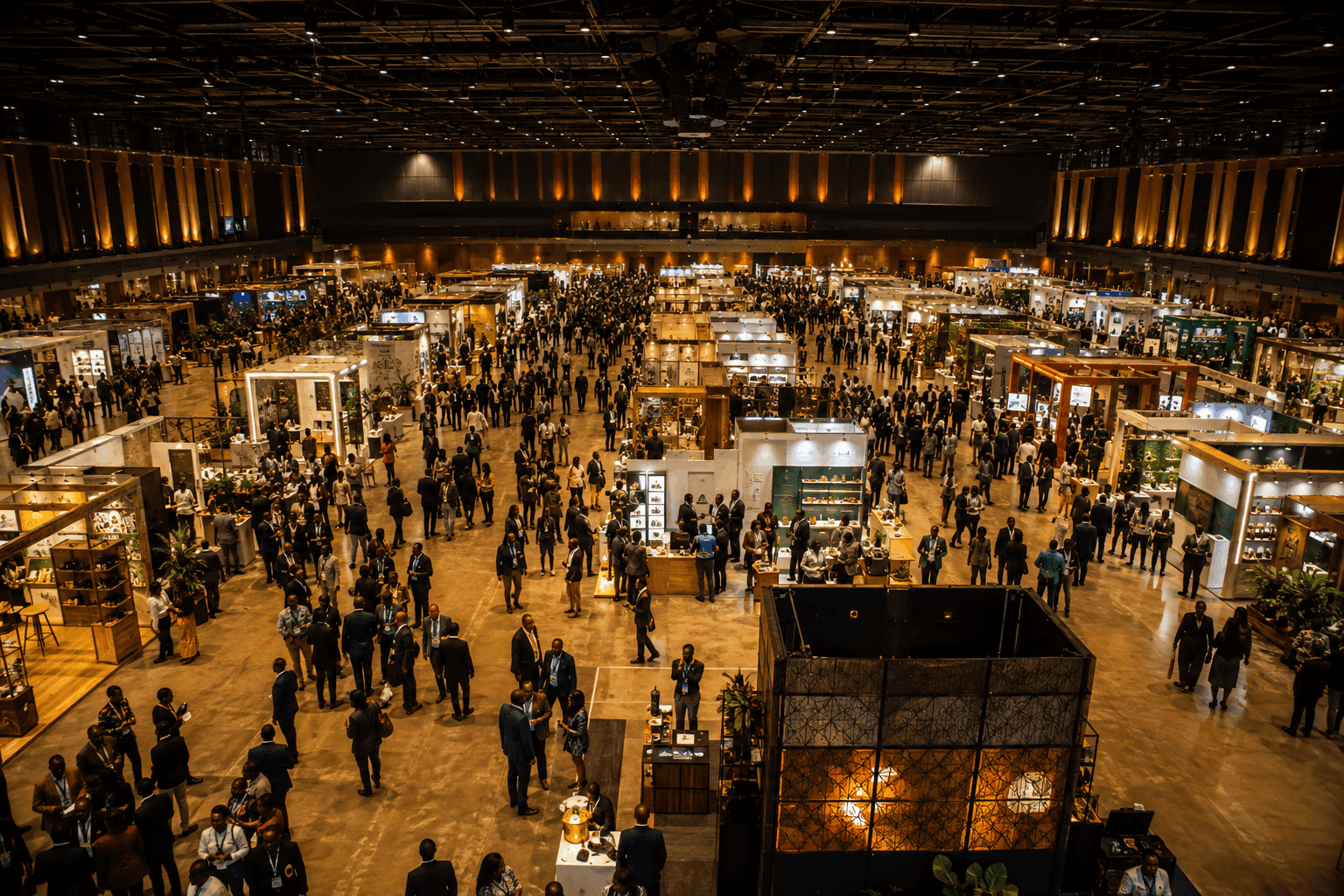
There is a threshold that trade platforms cross when they stop being events and start being institutions. It is not measured in delegate counts or square footage of exhibition space. It is measured in whether the sector starts organizing itself around the platform, whether buyers make sourcing decisions in anticipation of it, whether policymakers bring their agenda to it rather than the other way around.
ACT Expo crossed that threshold in 2026. It did it fast. The inaugural 2025 edition, held in Kigali over two days in July 2025, brought together 500 delegates, 50 exhibitors, and buyers from 11 countries. One year later, the 2026 edition drew more than 1,000 delegates, over 150 exhibitors, 100 hosted international buyers, and representatives from at least 25 countries. Every headline number more than doubled. The event also grew from two days to three.
That growth rate is not the result of better marketing. It is the result of the sector recognizing that something it needed had finally arrived. This article makes the case, from the inside, for why that recognition is correct and what it means for everyone in African coffee and tea going forward.
THE GROWTH ARGUMENT: WHAT DOUBLING IN ONE YEAR ACTUALLY SIGNALS
Trade platforms that double in a year are not doubling because of better advertising. They double because word traveled through the supply chain that something real happened at the first edition, and people who missed it decided not to miss the second one.
| Metric | ACT Expo 2025 | ACT Expo 2026 | Change |
| Delegates | ~500 | 1,000+ | +100% |
| Exhibitors | ~50 | 150+ | +200% |
| Hosted buyers | Not disclosed | 100+ | New program |
| Countries | 11 | 25+ | +127% |
| Duration | 2 days | 3 days | +50% |
| Competition format | Barista only | Barista + Tea Sommelier | Expanded |
Sources: NAEB ACT Expo 2025 retrospective (naeb.gov.rw); The New Times, June 2026; ACT Expo 2026 official communications
The Specialty Coffee Association’s World of Coffee platform, which launched in Europe in 2010 and has since expanded to multiple continents, took nearly a decade to become the reference event for the specialty sector. ACT Expo is moving on a different timeline, because the African coffee and tea sector is at a different stage of urgency. The price data from Mombasa, the AfCFTA trade architecture, the specialty market growth, and the consumer trust deficit I described across this series are all converging at the same moment. A platform that arrives at the convergence point gets adopted fast.
| A platform that arrives at the sector’s convergence point does not need to build momentum slowly. The momentum was already there. It needed somewhere to go. |
WHAT CONVERGENCE MEANS BEHAVIORALLY
I use the word convergence deliberately. In my research on the Communal Credibility Effect and how African producers build price premiums at international auction, I have argued that trust compounds when all the relevant parties are in the same room at the same time. A buyer who meets a producer, sees their product demonstrated, hears the policymaker who governs their sector, and shakes the hand of the logistics provider who moves their shipment in the same 72-hour period is not having four separate conversations. They are forming a single, compounded trust signal that no individual conversation can replicate.
ACT Expo 2026 did this at scale. The opening plenary I moderated brought together the EATTA Managing Director on regional tea trade, the AfCFTA Secretariat on continental trade architecture, the Kenya Ports Authority on Northern Corridor logistics, AGL Kenya on supply chain operations, the European Business Chamber Rwanda on the investment and buying perspective, and CEPAR on the domestic commercial landscape. Six contributions from six parts of the supply chain, in the same room, for the same audience, building a shared frame for the commercial conversations that followed on the exhibition floor.
That kind of convergence does not happen at bilateral meetings. It does not happen at ministerial trade missions. It does not happen online. It happens when a well-designed trade platform arrives at the right moment for its sector.
WHY THIS IS THE MOST BEHAVIORALLY SIGNIFICANT AFRICAN AGRIBUSINESS EVENT IN A DECADE
I make this claim with the precision that fifteen years of behavioral research gives me, and I am aware of what it implies. There have been significant African agribusiness events in the past decade: AFCA conferences, the African Fine Coffees Conference, the Mombasa Tea Festival, sector-specific trade missions, and bilateral investment summits. Each has produced value. None of them has assembled the full stakeholder ecosystem of a specific African commodity sector, across the entire value chain from farm gate to consumer, in a single commercial setting designed explicitly to produce trade agreements.
| FIVE REASONS ACT EXPO IS BEHAVIORALLY DISTINCT FROM PRIOR AFRICAN AGRIBUSINESS EVENTS |
| 1. IT IS BUILT AROUND COMMERCIAL OUTCOMES, NOT INFORMATION EXCHANGE. The Hosted Buyers Program brought buyers with confirmed sourcing mandates and pre-arranged meeting schedules. The B2B matchmaking system connected producers and exporters to relevant buyers before the exhibition floor opened. The event’s stated design goal was to produce trade agreements, not conference proceedings. This is a different architecture from a panel-heavy sector conference, and it produces different behavioral dynamics on the floor. |
| 2. IT ASSEMBLES THE COMPLETE VALUE CHAIN IN ONE ROOM. ACT Expo brought together farmers, cooperatives, processors, exporters, international buyers, logistics providers, trade finance institutions, policymakers, researchers, certification bodies, and technology providers simultaneously. No single part of the value chain was speaking to itself. The presence of each stakeholder category changes the behavior of all the others: producers pitch differently when buyers are watching, buyers commit differently when policymakers are present, investors act differently when the commercial case is being made live. |
| 3. IT IS ANCHORED IN A PRODUCING COUNTRY. The Mombasa Tea Auction is the price-discovery mechanism for East African tea, but it is not a destination that the producing sector owns. World of Coffee and the SCA Expo are exceptional platforms, but they are based in consuming markets. ACT Expo is built on the continent that grows the product. That geography is not symbolic. It changes the power dynamic of every conversation that happens there, because the producers are on home ground. |
| 4. IT HAS INSTITUTIONAL CONTINUITY. The co-organization by NAEB, the Rwanda Convention Bureau, and Rwanda Events Group gives ACT Expo an institutional backbone that most sector events lack. NAEB’s involvement means the platform is not dependent on private sponsorship cycles. The Rwandan government has a direct interest in its success and the institutional capacity to sustain it. That continuity is what converts a good event into a reference platform. |
| 5. IT ARRIVED AT THE CONVERGENCE POINT. AfCFTA is building the trade architecture for continental commerce. The specialty coffee and single-origin tea markets are growing at rates that reward African origin story and behavioral credibility. The African urban consumer is willing to pay more for local but needs the proof layer that most producers have not yet built. The Mombasa auction is bifurcating between premium-priced and average-priced origins at an accelerating rate. All of these forces were present before ACT Expo existed. What was missing was the room where they could be addressed by the right people simultaneously. That is what ACT Expo provides. |
WHAT THIS MEANS FOR THE SECTOR’S NEXT TWELVE MONTHS
The behavioral argument I have made across this entire series, and it points toward the same conclusion, that buyer trust drives price premiums, that the Extraction Reflex keeps producers at the commodity end of a market they could own, that five specific behavioral decisions separate premium-priced origins from commodity competitors, and that AfCFTA’s biggest barrier is not logistical but behavioral. All of that analysis points toward the same conclusion: the sector needs a convergence point where the behavioral work can happen at scale. ACT Expo is that point.
The next twelve months will tell us whether the relationships formed in Kigali in July convert into the price and volume data that matters. EATTA auction averages by origin, NAEB export revenue figures, and specialty trade press coverage of African origins will be the evidence. The producers who invested in named identity, consistency, and buyer relationships before and during ACT Expo are the ones whose numbers will move first.
And the platform itself will keep compounding. A trade event that doubled in year two has established a growth trajectory that makes ACT Expo 2027 a different proposition from ACT Expo 2026. The buyers who went in 2026 will bring colleagues in 2027. The producers who went in 2026 will come back with better documentation, stronger track records, and the relationship currency that the first edition started building.
| A platform that doubles in year two is not on a trend. It is on a trajectory. Those are different things, and they require different responses from the sector. |
WHY I WRITE THIS FROM INSIDE, NOT FROM THE SIDE
I moderated the Opening Plenary at ACT Expo 2026. I am the Director of Sales and Marketing at Rwanda Mountain Tea Ltd, Rwanda’s largest tea producer, the origin whose tea commands the highest average price at the Mombasa Tea Auction. I have spent fifteen years researching why African businesses underperform their own product quality and writing frameworks that diagnose the behavioral gap between what Africa produces and what it captures.
I do not write this as an outside observer making an encouraging assessment. I write it as a practitioner who has been in the room at both ends of this supply chain, who has sat at the Mombasa auction and watched buyer behavior, who has built export strategy for a Rwandan tea estate, and who moderated the conversation that opened ACT Expo 2026’s second day.
The convergence argument in this article is not enthusiasm. It is a behavioral diagnosis applied to a platform event, using the same analytical standards I apply to buyer psychology at Mombasa or to the Extraction Reflex in African agribusiness. The diagnosis is: ACT Expo has crossed the institutional threshold, and the sector should treat it accordingly.
WHAT COMES NEXT FOR BOTH THE PLATFORM AND THE SECTOR
- For producers and exporters: the relationships built at ACT Expo 2026 are assets that compound over the next twelve months. Follow-up is the entire game now. The B2B meeting that happened in Kigali in July is worth nothing if it is not followed by a sample shipment, a quality certificate, and a continued conversation in August.
- For buyers and importers: the origin intelligence gathered at ACT Expo is perishable. The producers who impressed at cupping, who demonstrated consistency, who had their auction track records documented and ready, are available now. Sourcing relationships formed within thirty days of an expo tend to be stickier than those formed later, because the shared experience is still recent.
- For policymakers and export boards: the Opening Plenary produced a clear institutional consensus on what the sector needs: behavioral trust infrastructure alongside logistical infrastructure, origin branding investment alongside certification, and a long-term view of the AfCFTA market alongside the short-term auction price. That consensus needs a policy expression before the next edition, not after.
- For investors and trade finance: the doubling of ACT Expo in a single year is the kind of market signal that precedes significant investment activity. The platform is validating commercial demand. The producers who demonstrate track records at ACT Expo 2026 are the ones who will make the strongest investment case in 2027.
- For the platform itself: the second edition has set an expectation that the third must meet. The behavioral infrastructure of a reference trade platform, the quality of the matchmaking, the calibre of the hosted buyers, the rigour of the competitive format, needs to scale with the delegate numbers. Growth that outruns quality destroys the trust that produced the growth. The organizers know this.
FREQUENTLY ASKED QUESTIONS
Why is ACT Expo described as behaviorally significant rather than simply successful?
Behavioral significance is a specific claim. It means the platform has changed how the sector’s stakeholders make decisions, not just how many of them gathered in one place. ACT Expo 2026 is behaviorally significant because it assembled buyers, producers, policymakers, logistics providers, and investors in a structured, commercially designed environment where each stakeholder’s behavior changed in the presence of the others. Producers pitched differently when buyers were watching. Buyers committed differently when policymakers were present. That multi-stakeholder dynamic is what converts a trade event into an institutional reference point for the sector.
What does it mean that ACT Expo doubled in size between its 2025 and 2026 editions?
The inaugural ACT Expo in July 2025 attracted approximately 500 delegates, 50 exhibitors, and buyers from 11 countries, according to NAEB’s official retrospective. ACT Expo 2026 drew more than 1,000 delegates, over 150 exhibitors, 100 hosted buyers, and representatives from at least 25 countries. Every headline metric more than doubled. A trade platform that doubles in its second year is not experiencing a promotional surge. It is experiencing the recognition effect: stakeholders who heard what happened in 2025 decided they could not afford to miss 2026. That recognition is the first signal of institutional status.
What is the convergence argument and why does it matter for African coffee and tea producers?
The convergence argument is that African coffee and tea was ready for a dedicated continental trade platform before ACT Expo existed, and that the arrival of the platform at the moment when AfCFTA, specialty market growth, and consumer trust dynamics are all simultaneously in motion accelerates the sector’s development faster than any of those forces would alone. For individual producers, the convergence argument means that the behavioral investments described across this series, in origin identity, buyer relationships, consistency, and value addition, now have a commercial arena in which to compound. The platform makes the work visible. Visible work builds the trust that produces premium prices.