
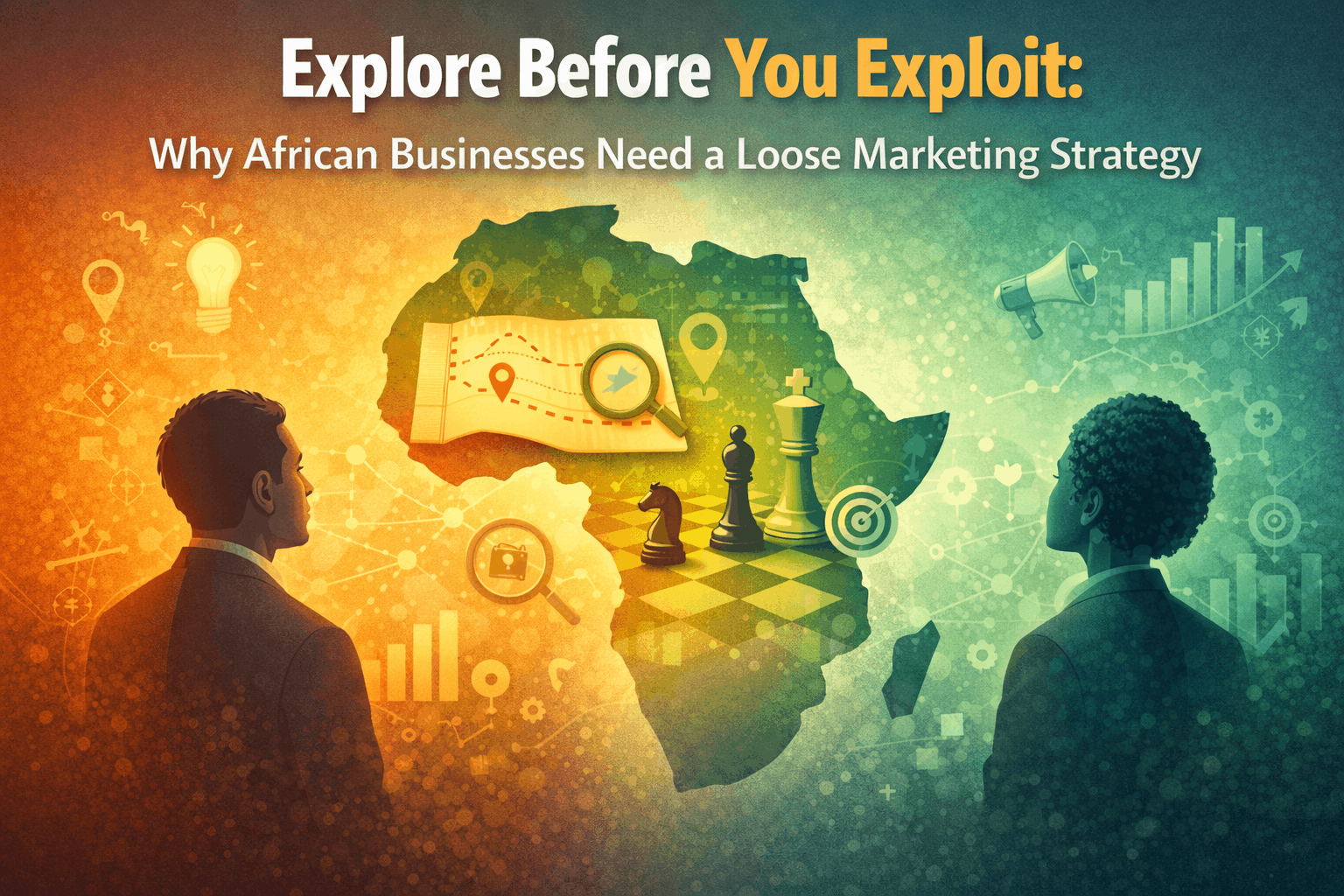
Our businesses are becoming more structured, more measured, more process-driven yet many are becoming less bold.
We are building dashboards faster than we are building differentiated brands. In emerging markets, that is a dangerous imbalance.
Africa does not reward rigidity. It rewards intelligent exploration.
Africa’s Markets Are Fluid, Not Fixed
In Rwanda, digital payment adoption accelerated faster than many legacy systems predicted. In Nigeria, consumer trends shift rapidly between formal and informal channels. In Kenya, mobile-first behavior redefined commerce long before traditional retail matured. In South Africa, brand identity and socio-economic narratives heavily influence purchasing decisions.
These are not stable, slow-moving environments.
They are adaptive ecosystems.
And adaptive ecosystems demand exploratory marketing.
Case 1: Mobile Money Exploration Before Optimization
When M-Pesa was launched by Safaricom in Kenya, it was not a perfectly optimized banking model. It began as an experiment to facilitate microfinance repayments via mobile phones. What followed was behavioral discovery.
Consumers began using it for peer-to-peer transfers. Then for commerce. Then for salary payments.
The company did not initially exploit a proven system. It explored a possibility and then optimized it.
Today, mobile money is embedded in the economic infrastructure of East Africa.
Exploration created the market. Exploitation scaled it.
Case 2: Fintech and Trust in Nigeria
In Nigeria, fintech brands like Flutterwave grew not merely by optimizing payment rails, but by experimenting with messaging around trust, youth empowerment, and digital entrepreneurship.
The environment was volatile. Regulatory frameworks evolved. Consumer skepticism toward financial systems existed.
Safe marketing would not have built credibility.
Bold positioning did.
Exploration of narrative preceded exploitation of infrastructure.
Case 3: Brand Identity and Pan-African Positioning
Consider how MTN Group positioned itself across multiple African markets. Its growth was not purely operational.
It experimented with emotional branding “Everywhere You Go” adapting culturally across regions rather than imposing a rigid, standardized communication template. In Africa, scale without cultural sensitivity fails.
Exploratory marketing enabled regional resonance.
Case 4: Rwanda’s Emerging Premium Brands
In Rwanda, premium hospitality and lifestyle brands have grown by testing experiential positioning rather than competing on price alone.
The rise of destination branding in Kigali did not come from aggressive short-term conversion metrics. It came from shaping perceptionĺ experimenting with narrative around safety, cleanliness, innovation, and ambition.
Brand-building required patience.
Measurement alone could not predict perception shifts.
The Strategic Mistake: Over-Optimization Too Early
Many African companies today attempt to measure before they discover.
They demand:
- Immediate ROI on every campaign
- Perfect attribution models
- Zero tolerance for marketing experiments
- Short-term sales justification
This creates incremental growth at best.
But in emerging markets, incrementalism is not enough.
The greatest opportunities in Africa lie in category creation, not marginal efficiency.
Why a Loose Marketing Strategy Works in Africa
A loose marketing approach in Africa means:
- Allocating a protected experimental budget
- Running controlled pilots in secondary cities
- Testing informal distribution channels
- Experimenting with community-driven storytelling
Measuring long-term brand trust, not just short-term clicks
African consumers respond strongly to narrative, aspiration, and social proof.
These variables are difficult to fully quantify before testing.
If you over-regulate marketing, you eliminate discovery.
And if you eliminate discovery, you eliminate breakthrough growth.
Africa’s Advantage Is Strategic Agility
Unlike saturated Western markets, Africa still offers whitespace.
Entire categories remain underdeveloped:
- Green mobility
- Digital education
- Health-tech access
- Creative industry monetization
The companies that will dominate these spaces will not be the most internally bureaucratic.
They will be the most intelligently experimental.
Exploration is not irresponsibility.
It is preparation for scale.
Final Reflection
In my analysis, the greatest threat to African business is not competition.
It is premature rigidity.
The discovery of Penicillin by Alexander Fleming reminds us that breakthroughs often begin in unexpected spaces but only flourish where there is room to explore.
Africa is still an exploratory market.
If we manage marketing purely through control systems and dashboards, we risk building efficient companies that lack strategic distinction.
Exploitation grows what we know.
Exploration reveals what Africa is becoming.
And those who explore early will lead tomorrow.