
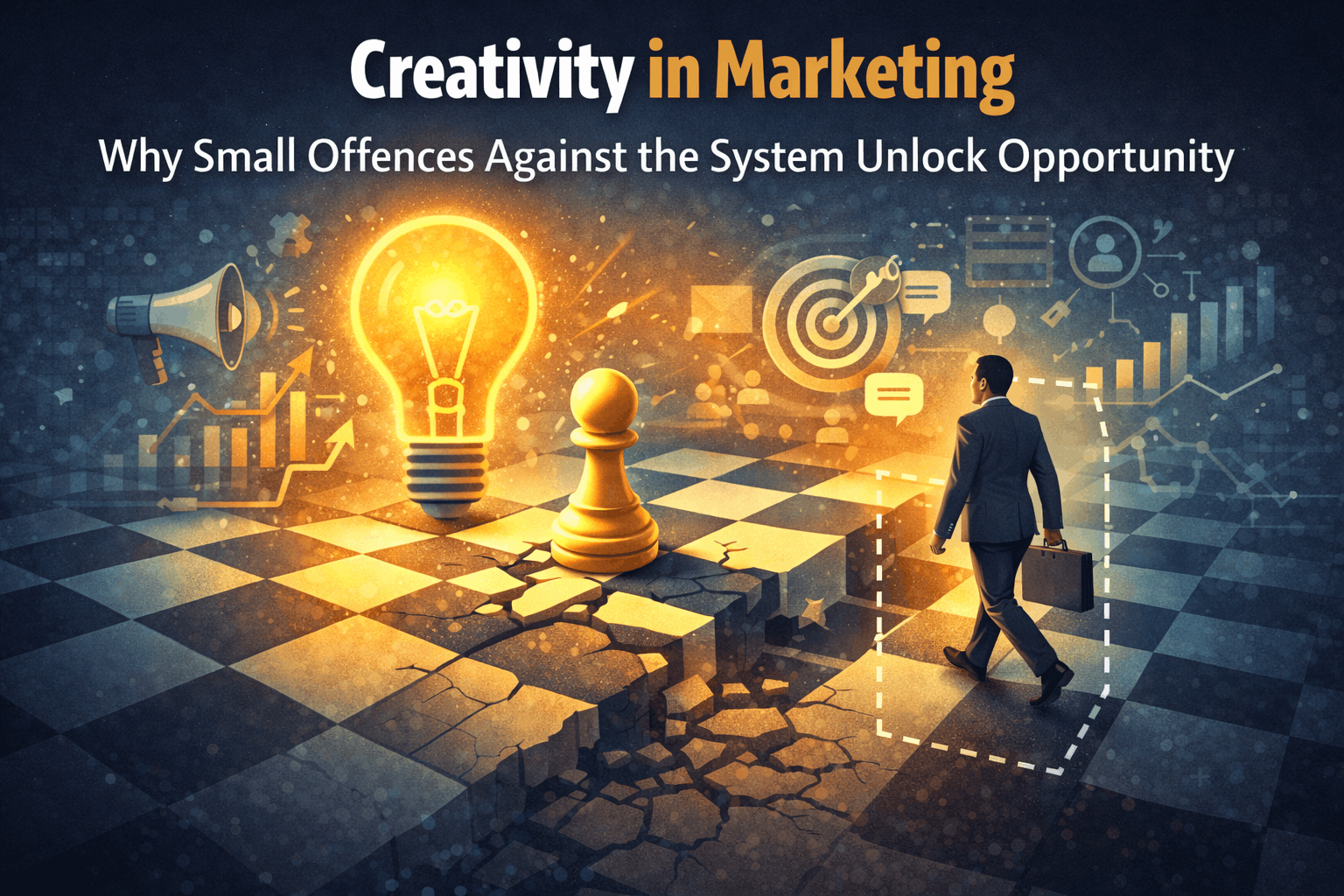
In business environments obsessed with structure, compliance, and process, creativity is often misunderstood. We tend to think of creativity as something mysterious or artistic an unpredictable spark reserved for designers or advertising agencies. But in marketing, creativity is far more practical than that.
To some extent, creativity occurs when the brain manages to bypass its own internal censorship mechanism.
Every professional operates with an internal filter. Before we speak, propose an idea, or try something unusual, the brain runs a quick audit: Is this acceptable? Will this work? Will this look professional? Most of the time, this internal censorship keeps organizations orderly and efficient. But it also quietly eliminates many unconventional ideas before they are even tested.
If we are constantly self-censoring, both consciously and unconsciously in what we think and do, there is a hidden opportunity cost.
Businesses rarely measure this cost. They measure budgets, conversion rates, and campaign performance. But they rarely measure the number of ideas that never make it past internal filters. Every suppressed idea represents a potential experiment that could have revealed something new about customers, markets, or messaging.
In marketing, creativity often means committing small offences against the system to unlock opportunities hidden within routines.
Routine is essential in business. Systems create consistency, predictability, and scale. But routines also create blindness. When everyone follows the same process, communicates in the same tone, and approaches customers in the same way, the market becomes saturated with identical signals.
Creativity breaks this pattern.
Not through rebellion for its own sake, but through small, intelligent deviations. A different message. A different channel. A different framing of value. These are small “offences” against the established system, but they are precisely what allow new opportunities to emerge.
Many breakthroughs in marketing do not come from perfect planning. They come from controlled experimentation at the edges of the system. When marketers are given enough freedom to test unconventional ideas, they increase the probability of discovering something unexpected.
In other words, creativity is not chaos. It is the deliberate permission to occasionally step outside the routine.
Organizations that eliminate these small deviations in the name of efficiency often end up with perfectly optimized processes that produce perfectly average results.
For businesses particularly in rapidly evolving markets across Africa the challenge is not simply to build systems. It is to build systems that leave room for intelligent rule-breaking.
Because sometimes the difference between an ordinary campaign and a breakthrough is simply this:
Someone allowed a small offence against the system.